What is Local Government?
Local government is the level of government closest to the people, making decisions that directly affect everyday life in your community. It includes city councils, county governments, school boards, municipal utility districts, and other local elected bodies that oversee services such as public safety, roads, parks, water, and education. These officials determine how local tax dollars are spent and establish policies that shape the quality of life for residents. Because local elections often have the greatest impact on families and neighborhoods, informed and engaged citizens play a vital role in ensuring accountable and effective leadership.
Government that impacts you the most many times gets 3%-5% turnout
Here is the breakdown of our local government here in Texas:
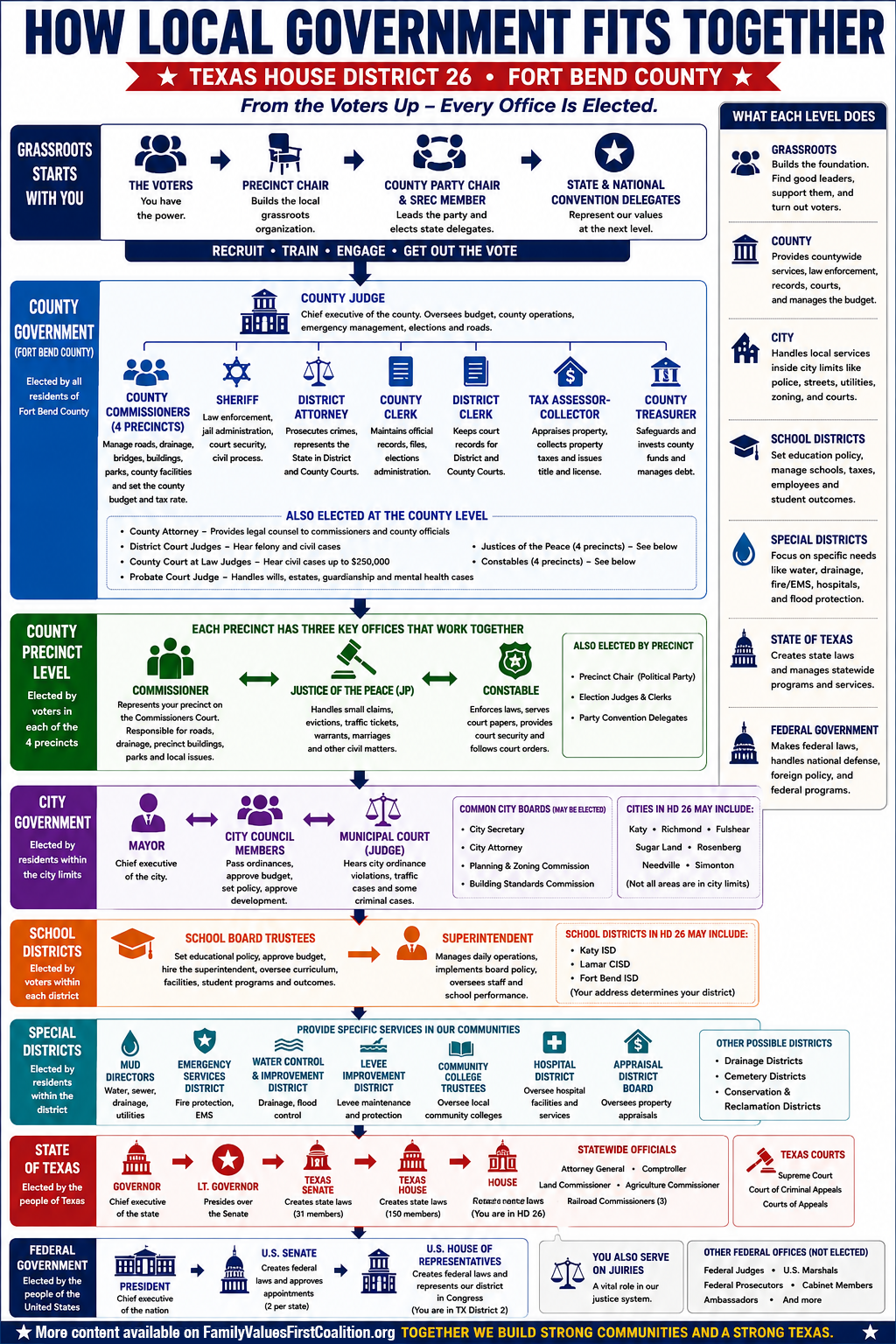
Summary of Local Government Players:
Political Party (Grassroots)
These aren’t government offices, but they’re often the entry point into politics.
- Precinct Chair (Republican or Democrat)
- County Party Chair
- State Republican Executive Committee (SREC) or State Democratic Executive Committee (SDEC) member
- State Convention Delegate
- National Convention Delegate (selected through party process)
A Precinct Chair is often the most influential volunteer position for building a local political movement.
Precinct-Level Government
These are actual elected government positions.
- Justice of the Peace (JP)
- Small claims
- Evictions
- Traffic tickets
- Weddings
- Constable
- Law enforcement
- Civil process
- Court security
Each serves one of Fort Bend County’s precincts.
County Government
Countywide offices include:
- County Judge
- County Commissioners (Precincts 1–4)
- Sheriff
- District Attorney
- County Attorney
- County Clerk
- District Clerk
- Tax Assessor-Collector
- County Treasurer
Numerous judges are also elected, including:
- District Court Judges
- County Court at Law Judges
- Probate Court Judges
These offices are elected every four years on staggered cycles.
School District
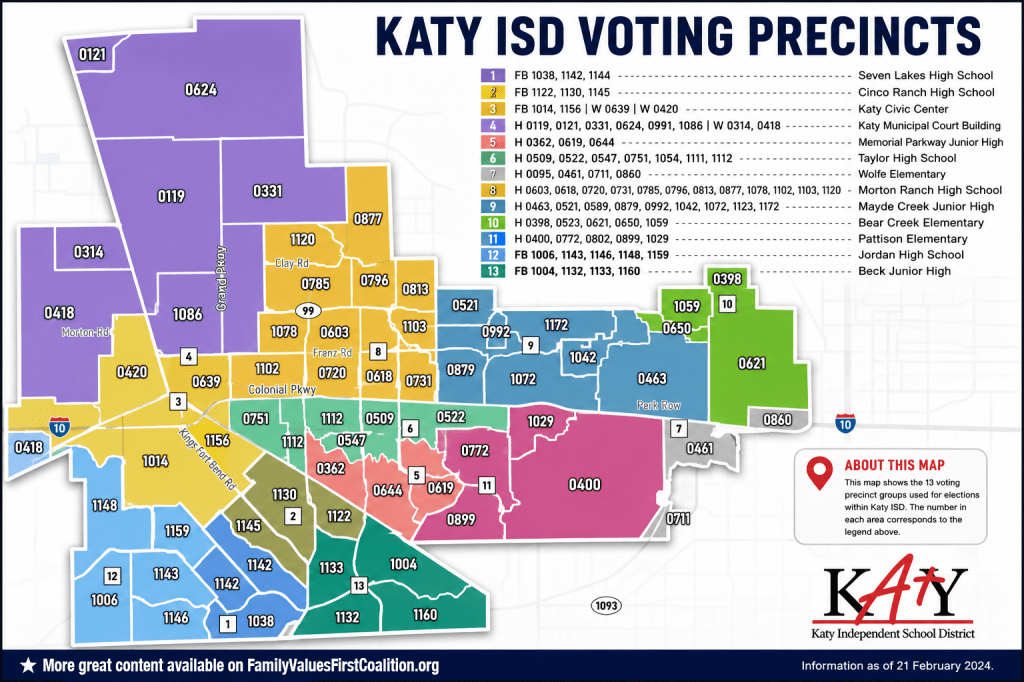
Depending on exactly where you live in Greater Katy, you’re likely in:
- Katy ISD
- Lamar CISD
- Fort Bend ISD
Each district elects:
- School Board Trustees
These are among the most important local races because trustees control curriculum, budgets, superintendent hiring, bond elections, and district policy.
City Government
If you live inside city limits (rather than unincorporated Fort Bend County), you also elect:
- Mayor
- City Council Members
- Sometimes Municipal Judge (depending on city charter)
Possible cities include:
- Katy
- Richmond
- Fulshear
- Sugar Land
- Rosenberg
- Needville
- Simonton
Special Districts
Many people don’t realize these are elected.
Depending on your address you may vote for:
- Municipal Utility District (MUD) Directors
- Emergency Services District (ESD) Commissioners
- Water Control & Improvement District Directors
- Levee Improvement District Directors
- Drainage District Directors
- Community College Trustees (if applicable)
- Hospital District Board members (where applicable)
- Appraisal District Board members (in some election cycles)
These boards often oversee multi-million-dollar budgets.
State Government
Your state-level elected officials include:
- Texas House Representative (House Districts)
- Texas State Senator (Senate District)
- Governor
- Lieutenant Governor
- Attorney General
- Comptroller
- Land Commissioner
- Agriculture Commissioner
- Railroad Commissioners (3 statewide)
- Texas Supreme Court Justices
- Court of Criminal Appeals Judges
Federal Government
You also vote for:
- U.S. House Representative
- U.S. Senator
- President (every four years)
Judicial Offices
Texas elects nearly all of its judges.
That includes:
- Justice of the Peace
- County Court at Law Judges
- Probate Judges
- District Judges
- Court of Appeals Justices
- Texas Supreme Court
- Texas Court of Criminal Appeals
THE GREATER KATY/FULSHEAR CITIZEN’S GUIDE TO STATE & LOCAL GOVERNMENT
Foundations of Government
Why Local Government Matters
Many people assume that the federal government has the greatest influence over their daily lives. In reality, most of the decisions that directly affect families are made much closer to home.
The roads you drive on, the quality of your children’s schools, emergency response times, property taxes, zoning decisions, parks, libraries, neighborhood drainage, and public safety are all primarily determined by state and local governments. These decisions are made by officials who often represent just a few thousand—or at most a few hundred thousand—people, making them more accessible and accountable than national leaders.
Because turnout in local elections is often low, individual votes carry greater weight. In some local races, only a few hundred votes separate the winner from the runner-up. An informed and engaged community can therefore have an outsized impact on the direction of local government.
County Government
Counties serve as the primary administrative division of Texas government. Every Texan lives within a county, regardless of whether they reside inside a city’s boundaries.
County governments are responsible for maintaining county roads and bridges, operating jails, administering elections, preserving official records, collecting certain taxes and fees, managing emergency operations, and supporting the judicial system.
Each county is governed by a Commissioners Court consisting of the County Judge and four County Commissioners.
City Government
Cities provide services within incorporated municipal boundaries.
Typical city responsibilities include:
- Police
- Fire protection
- Water and sewer
- Parks
- Libraries
- Streets
- Zoning
- Building permits
- Economic development
Cities are led by elected Mayors and City Councils.
School Districts
Independent School Districts (ISDs) are separate units of government. They are not departments of cities or counties.
School Boards establish educational policy, adopt budgets, hire superintendents, approve construction projects, and oversee district operations.
Because schools consume a substantial portion of local property taxes, School Board elections have a significant impact on both education and taxpayers.
Special Districts
Special districts exist to provide a single public service within a defined geographic area.
Examples include:
- Municipal Utility Districts (MUDs)
- Emergency Services Districts (ESDs)
- Water Control & Improvement Districts
- Levee Improvement Districts
- Community College Districts
- Hospital Districts
Many residents are unaware that these districts have elected boards and taxing authority.
The Texas Court System
Texas has one of the nation’s most complex judicial systems.
Common local courts include:
- Municipal Courts
- Justice Courts
- County Courts at Law
- District Courts
- Probate Courts
Appeals progress to the Courts of Appeals and, depending on the case, either the Texas Supreme Court (civil matters) or the Texas Court of Criminal Appeals (criminal matters).
Who Pays for Government?
Government services are funded through a combination of:
- Property taxes
- Sales taxes
- State franchise taxes
- Vehicle registration fees
- Court fees
- Federal grants
- Utility fees
- Bonds
Each level of government relies on different funding sources and has different taxing authority.
Separation of Powers
Texas government is divided into three branches:
- Legislative (makes laws)
- Executive (administers laws)
- Judicial (interprets laws)
This separation is designed to ensure that no single branch exercises unchecked authority.
Why Local Elections Matter
Local elections frequently experience turnout below 15% of registered voters as low as 3% in May elections). As a result, relatively small numbers of engaged citizens can significantly influence outcomes.
The officials elected in these contests make decisions that directly affect property taxes, school quality, public safety, infrastructure, and neighborhood development.
Becoming an Engaged Citizen
Citizens can make a difference by:
- Voting in every election
- Attending public meetings
- Contacting elected officials
- Serving on advisory boards
- Volunteering in campaigns
- Becoming a Precinct Chair
- Running for public office
Description of Elected Positions:
Precinct Chair
The Precinct Chair is often called the “backbone” of a political party because this volunteer leader represents the party within a single voting precinct. Although the office receives little public attention, it is one of the most influential grassroots positions in local politics.
Precinct Chairs are elected during party primary elections. They organize neighborhood volunteers, welcome new residents, identify potential candidates, register voters, and encourage participation in elections. They also represent their precinct during county party meetings and may vote on party business.
Because Precinct Chairs know their neighborhoods better than anyone else, they often become trusted sources of information for both voters and candidates. Many elected officials first became involved in public service by serving as Precinct Chairs.
Typical Responsibilities
- Meet voters within the precinct
- Recruit volunteers
- Help register new voters
- Educate neighbors about upcoming elections
- Organize block walking
- Encourage voter turnout
- Attend county party meetings
- Assist candidates during campaigns
- Recommend delegates to conventions
County Government
County Judge
Chief Executive of the County
Despite the title, the County Judge is usually not a courtroom judge in large counties like Fort Bend.
Instead, this office serves as the county’s chief executive officer.
Primary Responsibilities
Presides over Commissioners Court.
Prepares the county budget.
Coordinates emergency management.
Represents the county.
Works with state and federal agencies.
Oversees county administration.
Coordinates disaster response.
Leads long-range planning.
The County Judge often becomes the public face of the county during hurricanes, floods, pandemics, and other emergencies.
Why Citizens Should Care
The County Judge helps determine:
• How your tax dollars are spent
• Which roads get improved
• Flood control priorities
• Public safety investments
• County employee compensation
• Major construction projects
Typical Qualifications
Minimum age:
18
Texas resident
County resident
Registered voter
No felony conviction (unless rights restored)
Term
Four years
Fun Fact
Fort Bend County’s annual budget exceeds $700 million, meaning the County Judge helps oversee spending comparable to many large corporations.
County Commissioner
Each Commissioner represents approximately one-fourth of the county.
Think of them as county council members.
They are responsible for balancing the needs of their precinct with those of the entire county.
Responsibilities
Roads
Bridges
Drainage
County parks
County buildings
Infrastructure
Capital improvements
Budget approval
Emergency planning
Economic development
Common Misconception
Many people believe Commissioners only manage roads.
In reality they help oversee virtually every county expenditure.
Sheriff
The Sheriff is the county’s chief law enforcement officer.
Responsibilities include:
Operating the county jail
Serving civil process
Court security
Patrolling unincorporated areas
Warrant service
Criminal investigations
Emergency response
Mutual aid
The Sheriff’s Office may employ hundreds—or even thousands—of deputies depending on county size.
What the Sheriff Does NOT Do
The Sheriff does not prosecute crimes.
That responsibility belongs to the District Attorney.
District Attorney
Represents the State of Texas.
Responsibilities include:
Felony prosecution
Grand juries
Victim assistance
Plea agreements
Trial litigation
Criminal appeals
Advice to law enforcement
The District Attorney’s client is the people of Texas, not county government.
County Attorney
The County Attorney serves as the county’s lawyer.
Responsibilities include:
Civil lawsuits
Legal advice
Contracts
Open records
Public information
Some misdemeanor prosecution
Representation of county departments
County Clerk
The County Clerk preserves history.
Responsibilities include:
Marriage licenses
Birth records (where applicable)
Property records
Commissioners Court minutes
Business filings
Election records
Public archives
Many records maintained by County Clerks date back more than 150 years.
District Clerk
Supports District Courts.
Maintains:
Civil lawsuits
Felony records
Jury management
Court documents
Evidence records
Judgments
Appeals
Without the District Clerk, courts could not legally function.
Tax Assessor-Collector
This office:
Collects property taxes
Issues vehicle registrations
Processes title transfers
Collects certain fees
Administers voter registration in some counties
The office does NOT determine property values.
That is done by the Appraisal District.
County Treasurer
Acts as the county’s banker.
Responsibilities include:
Receiving county money
Investing county funds
Payroll
Cash management
Financial reporting
Protecting taxpayer dollars
County Auditor (Appointed)
Although not elected, this is one of the most powerful financial positions in county government.
The Auditor:
Audits every department.
Reviews expenditures.
Ensures legal compliance.
Approves financial transactions.
Reports directly to District Judges.
County Engineer (Appointed)
Responsible for:
Road design
Bridge projects
Drainage
Traffic studies
Flood mitigation
Subdivision review
Construction oversight
County Departments
A modern county may include:
Animal Services
Veterans Services
Public Health
Emergency Management
Engineering
Road & Bridge
Information Technology
Human Resources
Purchasing
Facilities
Parks
Libraries (some counties)
Medical Examiner (where applicable)
Fire Marshal
Local Judicial Courts
Municipal Courts
Municipal Courts are city courts.
They typically hear:
- Traffic tickets
- Parking violations
- City ordinance violations
- Class C misdemeanors
Most people who receive a speeding ticket inside city limits will appear in Municipal Court.
Municipal Judges may be elected or appointed depending on the city’s charter.
Why Citizens Should Care
Municipal Courts process hundreds of thousands of cases each year and often represent a person’s first interaction with the judicial system.
Justice of the Peace Courts
Justice Courts are often called the “People’s Court.”
They handle:
- Small Claims
- Debt lawsuits
- Evictions
- Civil cases up to the statutory limit
- Repair and Remedy cases
- Magistrate duties
- Search warrants
- Arrest warrants
- Weddings
Justice of the Peace Judges are elected by precinct.
Many residents will interact with a Justice Court long before they ever appear in a District Court.
County Courts at Law
County Courts at Law hear a wide variety of cases depending on the county.
Typical cases include:
- Misdemeanors
- Family law
- Civil lawsuits
- Appeals from Justice Courts
- Juvenile matters (in some counties)
These courts relieve the workload of District Courts by handling many intermediate cases.
Probate Courts
Probate Courts handle matters involving:
- Wills
- Estates
- Guardianships
- Mental health commitments
- Trust administration
Although probate is commonly associated with inheritance, these courts also protect minors and adults who are unable to care for themselves.
Many families interact with Probate Court after the death of a loved one.
District Courts
District Courts are the primary trial courts in Texas.
They hear:
Criminal
- Felonies
- Murder
- Sexual assault
- Major drug offenses
- Armed robbery
Civil
- Divorce
- Child custody
- Large lawsuits
- Election disputes
- Business litigation
- Constitutional issues
- Land disputes
District Judges preside over jury trials and make decisions that can significantly affect individuals, businesses, and local governments.
Specialty Courts
Many counties have created specialty courts to address specific challenges.
Examples include:
- Veterans Court
- Drug Court
- DWI Court
- Mental Health Court
- Family Recovery Court
- Commercial Court (new in Texas)
These courts focus on rehabilitation, treatment, or efficient resolution of specialized cases.
Courts of Appeals
Texas has intermediate appellate courts.
These courts do not retry cases.
Instead, they determine whether the trial court correctly applied the law.
Most appeals from District Courts are reviewed here before potentially reaching one of Texas’s highest courts.
Texas Supreme Court
The Texas Supreme Court is the highest court for civil cases.
It decides issues involving:
- Constitutional questions
- Major business disputes
- Election law
- Property rights
- Statewide legal questions
Its decisions become binding precedent for every lower civil court in Texas.
Texas Court of Criminal Appeals
Texas is one of only two states with separate highest courts for civil and criminal cases.
The Court of Criminal Appeals hears:
- Death penalty appeals
- Major criminal appeals
- Criminal constitutional issues
- Statewide criminal precedent
Its rulings govern every criminal court in Texas.
City Government
Mayor
The Community’s Chief Elected Leader
The Mayor serves as the public face of the city and provides leadership to the City Council.
Responsibilities vary depending on the city’s charter, but commonly include:
- Presiding over City Council meetings.
- Representing the city at public events.
- Working with neighboring governments.
- Supporting economic development.
- Leading during emergencies.
- Helping establish policy priorities.
In some cities, the Mayor votes only to break ties. In others, the Mayor has voting authority equal to council members.
Why Citizens Should Care
The Mayor often sets the tone for city government, communicates with residents during emergencies, and helps guide the city’s long-term vision.
City Council
The City’s Board of Directors
City Council Members represent residents and make legislative decisions for the city.
Together, they:
- Adopt the annual budget.
- Set property tax rates.
- Pass local ordinances.
- Approve major contracts.
- Oversee city services.
- Approve new developments.
- Invest in infrastructure.
- Plan for future growth.
City Council decisions affect nearly every aspect of daily life.
How City Council Meetings Work
A typical meeting follows this format:
- Call to Order
- Public Comments
- Consent Agenda
- Department Reports
- New Business
- Ordinances
- Budget Items
- Executive Session (if needed)
- Adjournment
Residents usually have an opportunity to speak during public comment before major decisions are made.
City Manager (Where Applicable)
Many Texas cities—including several in the Greater Katy/Fulshear area—operate under a Council-Manager form of government.
The City Manager is appointed, not elected.
Responsibilities include:
- Managing daily city operations.
- Supervising department directors.
- Preparing the annual budget.
- Hiring city employees.
- Implementing City Council policies.
- Overseeing city contracts.
Think of the City Manager as the city’s Chief Executive Officer.
Municipal Judge
Municipal Courts hear cases involving:
- Traffic violations.
- Parking citations.
- City ordinance violations.
- Class C misdemeanors.
Municipal Judges ensure cases are handled fairly and according to Texas law.
Depending on the city’s charter, judges may be elected or appointed.
Planning & Zoning
One of the most important responsibilities of city government is managing growth.
Planning and Zoning includes:
- Residential development.
- Commercial development.
- Subdivision approval.
- Rezoning requests.
- Building heights.
- Parking requirements.
- Land use planning.
Most cities use Planning & Zoning Commissions to review projects before they reach City Council.
Police Department
City police officers are responsible for:
- Patrol.
- Criminal investigations.
- Traffic enforcement.
- Community policing.
- School resource officers.
- Emergency response.
- Crime prevention.
Unlike the Sheriff’s Office, city police generally operate only within city limits.
Fire Department & EMS
City fire departments provide:
- Fire suppression.
- Rescue operations.
- Emergency medical response (in some cities).
- Hazardous materials response.
- Fire inspections.
- Public education.
In some communities, emergency medical services are provided through Emergency Services Districts rather than city government.
Public Works
Public Works departments maintain much of the infrastructure residents rely on every day.
Responsibilities include:
- Streets.
- Sidewalks.
- Storm drainage.
- Traffic signals.
- Water lines.
- Sewer systems.
- Street signs.
- Fleet maintenance.
These departments often manage some of the largest portions of the city’s budget.
Parks & Recreation
Parks departments oversee:
- Community parks.
- Sports fields.
- Playgrounds.
- Trails.
- Community centers.
- Recreation programs.
- Youth sports.
- Special events.
High-quality parks contribute significantly to property values and quality of life.
Building Permits & Code Enforcement
Cities regulate construction to ensure safety and compliance with building codes.
Departments review:
- New homes.
- Commercial buildings.
- Remodeling.
- Electrical work.
- Plumbing.
- Mechanical systems.
Code Enforcement addresses issues such as:
- Tall grass.
- Junk vehicles.
- Dangerous structures.
- Illegal signage.
- Property maintenance.
Economic Development
Cities actively recruit new businesses and encourage investment.
Economic development efforts may include:
- Infrastructure improvements.
- Incentive agreements.
- Workforce partnerships.
- Tourism.
- Downtown revitalization.
- Business retention.
A growing tax base helps fund city services without placing additional burdens on homeowners.
How Cities Pay for Services
Common revenue sources include:
- Property taxes.
- Sales taxes.
- Utility payments.
- Building permits.
- Franchise fees.
- Hotel occupancy taxes.
- Court fines.
- Grants.
Cities prepare annual budgets that determine how these funds will be spent.
School District Government
What Is an Independent School District?
Texas public schools are organized into Independent School Districts (ISDs). An ISD is a separate unit of government created under Texas law to provide public education within a defined geographic area.
An ISD is not controlled by the city, county, or state government. Instead, each district is governed by an elected Board of Trustees that hires a Superintendent to manage day-to-day operations.
Examples in the Greater Katy/Fulshear area include:
- Katy Independent School District (Katy ISD)
- Lamar Consolidated Independent School District (Lamar CISD)
- Fort Bend Independent School District (FBISD)
Each district has its own budget, tax rate, election schedule, and governing board.
How School Districts Are Different
Unlike a city or county, a school district has one primary mission:
To educate students and prepare them for success in life.
School districts do not provide police patrols, repair roads, or issue building permits. Their responsibilities are focused on education, student safety, transportation, nutrition, facilities, and supporting teachers and staff.
This narrow focus allows school districts to specialize in serving students and families.
The School Board of Trustees
The Governing Body of the District
The School Board is the legislative body of the school district. Trustees are elected by the public and are responsible for establishing district policies, adopting budgets, hiring and evaluating the Superintendent, and ensuring that the district fulfills its educational mission. There are 7 Trustees in Katy ISD
Trustees do not manage the district’s daily operations. Their role is to provide oversight, set direction, and hold the Superintendent accountable.
Primary Responsibilities
- Adopt district policies
- Hire and evaluate the Superintendent
- Approve the annual budget
- Set the local tax rate (subject to state law)
- Approve curriculum resources where permitted
- Authorize construction projects
- Call bond elections
- Monitor academic performance
- Represent the interests of the community
What Trustees Do Not Do
A common misconception is that trustees run the schools.
They do not:
- Hire individual teachers
- Select classroom assignments
- Manage campuses
- Approve daily lesson plans
- Supervise principals
- Handle routine discipline
Those responsibilities belong to the Superintendent and district administration.
The Superintendent
The Chief Executive Officer of the District
The Superintendent is hired by the School Board and serves as the district’s chief executive officer.
Responsibilities include:
- Managing daily operations
- Supervising principals
- Hiring employees
- Implementing Board policies
- Preparing the annual budget
- Overseeing transportation
- Maintaining facilities
- Responding to emergencies
- Improving academic performance
Think of the Superintendent as the CEO and the School Board as the Board of Directors.
District Administration
Supporting the Superintendent are numerous administrative departments, including:
- Curriculum & Instruction
- Human Resources
- Finance
- Transportation
- Technology
- Facilities & Maintenance
- Athletics
- Communications
- Special Education
- Safety & Security
- Child Nutrition
Large districts like Katy ISD may employ thousands of teachers and staff and operate dozens of campuses.
School Board Meetings
School Board meetings are open to the public under the Texas Open Meetings Act.
A typical meeting includes:
- Call to Order
- Public Comments
- Consent Agenda
- Academic Reports
- Financial Reports
- Policy Updates
- Construction Updates
- New Business
- Executive Session (if needed)
- Action Items
- Adjournment
Residents may generally address the Board during designated public comment periods.
Curriculum & Academic Standards
The Texas Essential Knowledge and Skills (TEKS) establish the academic standards that public schools are required to teach.
Local school boards may approve instructional materials and establish district policies, but curriculum standards are largely determined at the state level through the Texas Education Agency (TEA) and the State Board of Education (SBOE).
Districts also determine:
- Course offerings
- Career and Technical Education (CTE) programs
- Advanced Placement (AP) opportunities
- Dual-credit partnerships
- Extracurricular programs
School Finance
School districts manage some of the largest public budgets in local government.
Major expenditures include:
- Teacher salaries
- Employee benefits
- Transportation
- School safety
- Utilities
- Technology
- Facilities
- Instructional materials
- Athletics
- Maintenance
The Board adopts a balanced annual budget after public discussion.
Property Taxes & School Funding
School districts receive funding from several sources:
- Local property taxes
- State education funding
- Federal grants
- Student meal reimbursements
- Other program revenues
In many communities, the school district receives the largest portion of a homeowner’s property tax bill.
Understanding how these funds are used is essential for informed civic participation.
School Bond Elections
When districts need to build new schools, renovate aging facilities, purchase land, or improve security, they may ask voters to approve a bond election.
If approved, the district issues bonds that are repaid over time through property tax revenues.
Typical bond projects include:
- New campuses
- Classroom additions
- Technology upgrades
- Athletic facilities
- Safety improvements
- Transportation equipment
Voters—not the School Board—have the final say on whether bonds are approved.
Accountability Ratings
Texas evaluates school districts using an accountability system that considers:
- Student achievement
- Academic growth
- College, career, and military readiness
- Graduation rates
- Closing achievement gaps
These ratings provide one measure of district performance, although families may also consider campus culture, extracurricular opportunities, and community involvement.
Parents’ Rights
Parents play a vital role in public education.
Texas law provides parents with opportunities to:
- Review instructional materials
- Attend School Board meetings
- Meet with teachers and administrators
- Request information under the Public Information Act
- Participate in parent organizations
- Speak during public comment
- Vote in School Board elections
Strong partnerships between schools and families contribute to student success.
Public Participation
School districts encourage community involvement through:
- Board meetings
- Advisory committees
- Campus improvement teams
- Booster clubs
- Parent-teacher organizations
- Volunteer programs
Constructive public participation helps districts make informed decisions that reflect community priorities.
Common Misconceptions
“The School Board writes the curriculum.”
No. The State of Texas establishes academic standards through the TEKS. Local boards primarily adopt policies and instructional materials within the framework of state law.
“The Superintendent answers to the Mayor.”
No. The Superintendent is employed by and accountable to the elected School Board.
“School districts are part of city government.”
No. School districts are independent governmental entities with their own elected governing boards.
Special Districts
Municipal Utility Districts (MUDs)
One of the Most Important Local Governments
Municipal Utility Districts, commonly called MUDs, are among the most common Special Districts in suburban Texas.
Many residents in the Greater Katy and Fulshear area live within a MUD.
What Does a MUD Do?
A MUD may provide:
- Water service
- Wastewater (sewer)
- Storm drainage
- Parks and recreational facilities
- Road improvements (in some districts)
- Regional detention ponds
- Utility infrastructure
The district constructs, owns, and maintains much of the infrastructure that serves the community.
MUD Board of Directors
Residents elect a Board of Directors.
The Board typically consists of five members.
Responsibilities include:
- Adopting the annual budget
- Setting tax rates
- Approving utility rates
- Issuing bonds
- Awarding contracts
- Hiring engineers and consultants
- Planning future infrastructure
Although many meetings attract few attendees, these boards oversee millions of dollars in public assets.
How MUDs Pay for Infrastructure
When a new neighborhood is developed, the MUD often issues bonds to finance major infrastructure such as water plants, sewer systems, drainage facilities, and detention ponds.
Property owners repay those bonds over time through property taxes.
As bonds are paid down, the district’s debt decreases, although tax rates may also change based on maintenance needs and future projects.
Emergency Services Districts (ESDs)
Emergency Services Districts provide emergency response services in areas that may not be served by a municipal fire department.
Typical services include:
- Fire suppression
- Emergency medical services (EMS)
- Rescue operations
- Hazardous materials response
- Public safety education
Many residents outside city limits rely entirely on an ESD for emergency services.
ESD Commissioners
Residents elect Commissioners who oversee:
- Annual budgets
- Fire station construction
- Ambulance services
- Equipment purchases
- Staffing
- Tax rates
- Service contracts
The Board ensures the district has the resources needed to respond quickly during emergencies.
Levee Improvement Districts
Flood protection is critical in many parts of Southeast Texas.
Levee Improvement Districts are responsible for constructing, maintaining, and improving levees and flood control systems.
Responsibilities include:
- Levee maintenance
- Pump stations
- Flood gates
- Drainage systems
- Engineering inspections
- Emergency flood response
These districts help protect lives, homes, and businesses from flooding.
Water Control & Improvement Districts
These districts manage:
- Water supply
- Drainage
- Irrigation
- Flood control
- Water quality
- Infrastructure improvements
Although similar to MUDs, Water Control & Improvement Districts often have broader responsibilities depending on their enabling legislation.
Drainage Districts
Drainage Districts focus specifically on managing stormwater.
Responsibilities include:
- Ditches
- Canals
- Culverts
- Stormwater detention
- Flood mitigation
- Channel maintenance
Proper drainage protects neighborhoods from flooding during heavy rainfall.
Municipal Management Districts
Some commercial areas establish Municipal Management Districts to improve economic development.
Typical responsibilities include:
- Beautification
- Landscaping
- Public safety initiatives
- Business recruitment
- Marketing
- Public improvements
- Maintenance
Funding often comes through assessments on commercial property owners.
Community College Districts
Community College Districts are independent governments responsible for operating local colleges.
Residents elect Trustees who oversee:
- Tuition policies
- Campus construction
- Academic programs
- Workforce training
- District finances
Community colleges play an essential role in preparing students for careers, certifications, and university transfer.
Hospital Districts
Hospital Districts exist to ensure access to public healthcare.
Responsibilities may include:
- Public hospitals
- Clinics
- Emergency care
- Preventive medicine
- Community health initiatives
Some Hospital Districts are governed by elected boards, while others are appointed, depending on state law and local structure.
Appraisal Districts
Every county has an Appraisal District responsible for determining the taxable value of property.
The Appraisal District:
- Appraises property
- Maintains ownership records
- Administers exemptions
- Conducts reappraisals
- Supports Appraisal Review Boards
Important: The Appraisal District does not collect taxes or set tax rates.
Those responsibilities belong to the individual taxing entities.
How Special Districts Are Funded
Funding sources vary by district.
Common revenue includes:
- Property taxes
- Utility fees
- Service charges
- Bond proceeds
- Grants
- User fees
Unlike cities, many Special Districts have a single revenue source, making careful financial planning essential.
Special District Elections
Many Special District Boards are elected by residents living within the district.
Because turnout is often low, these elections can be decided by relatively small numbers of voters.
Serving on a Special District Board is an excellent way for citizens to become involved in local government and help shape the future of their communities.
 Family Values First Coalition